
We may have a huge poop explosion to thank for the existence of complex life on Earth, according to scientists.
A new study, published in Trends in Ecology & Evolution, has credited this ‘faecal revolution’ with influencing one of the most significant turning points in animal and environmental evolution.
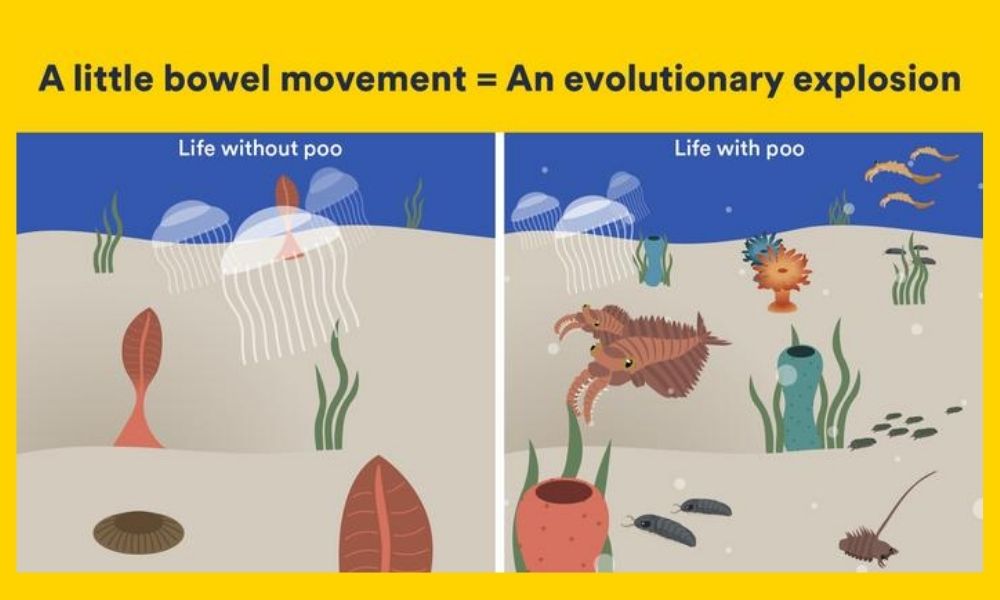
Researchers from Flinders University have suggested that a build-up of excrement from primitive sea creatures may have been a core trigger for the Cambrian explosion – a period around 540 million years ago when most major animal groups emerged.
“Next to rising oxygen levels and other contributing factors, the importance of faeces in ancient ecosystems is often overlooked,” said Dr Russell Bicknell, an Australian Research Council Discovery Early Career Researcher Award (DECRA) fellow at Flinders University’s College of Science and Engineering.
Poop from prehistoric sea creatures, said the scientists, encouraged marine life to evolve and diversify.
Bicknell explained that “increasingly sophisticated digestive systems” were part of a bigger picture that helped more nutrients pour into ancient oceans.
This, he continued, sped up the development of marine ecosystems in the later Ediacaran and early Cambrian periods.
Fossilised faeces, known as coprolites, contain vital information that logs the history of our planet’s evolution.
Throughout the study, researchers observed how the variety of coprolites increased as the Cambrian period progressed – a key indicator of evolution.
“The faecal matter includes microscopic pellets through to centimetre-scale coprolites containing shells and other animal fragments,” said Bicknell.
“It becomes clear in the fossil record that the evolution of feeding strategies aligns with the production and distribution of organic carbon and nutrients, to start creating conditions we see in modern oceans and later on land, where fertiliser today is used to produce our food.”
Read more:
