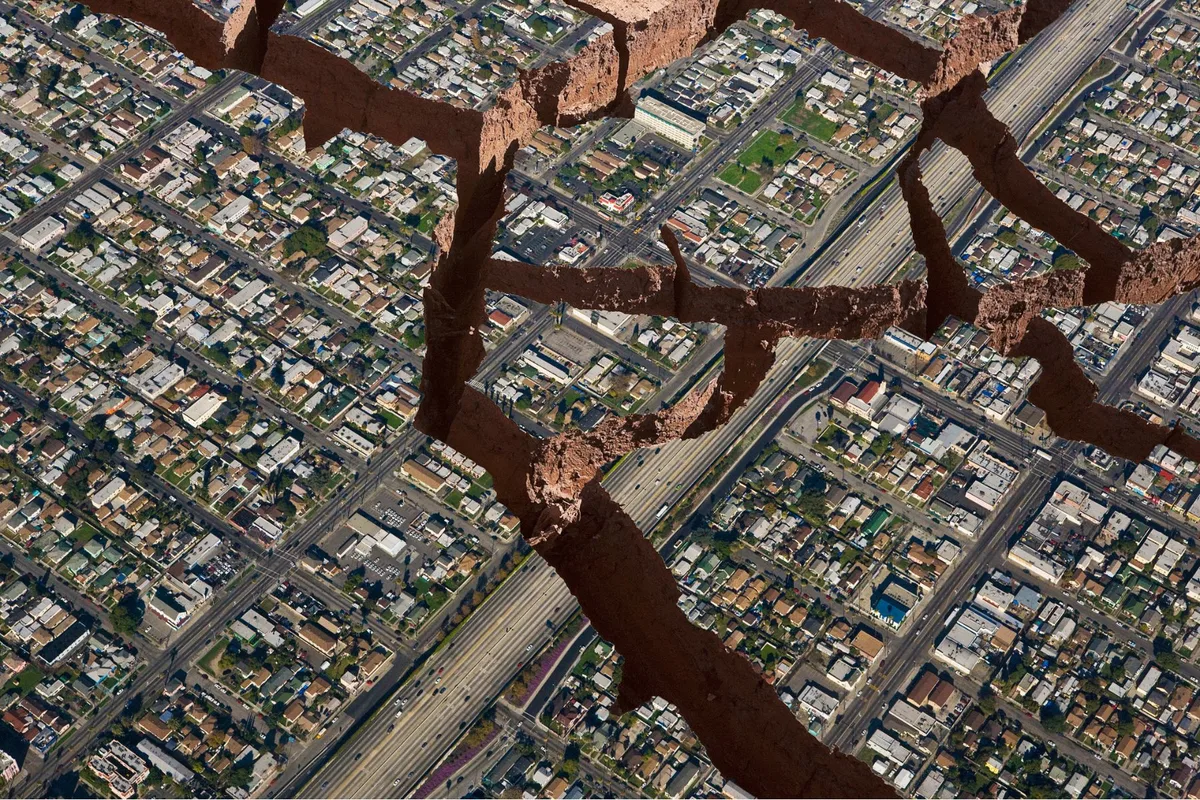
Scientists are warning that an earthquake could be heading to California, as recent research suggests that seismic pressure in two big fault lines is the highest at any point over the last 1,000 years.
The new paper, published in the Journal of Geophysical Research, does not predict when a quake will strike. But it finds the southern San Andreas and San Jacinto faults are now carrying more pent-up stress than at any point in the past millennium – a state the authors call "critically loaded".
California's last earthquake on a similar scale was the magnitude-7.9 San Francisco earthquake of 18 April 1906, which killed around 3,000 people and devastated much of the Bay Area.
But while that disaster unleashed enormous amounts of energy, it did so on the northern San Andreas Fault. The southern fault systems examined in the new study were unaffected.
Because earthquakes in one part of the fault network do not relieve pressure elsewhere, researchers say these southern sections have continued accumulating strain for decades – and in some places centuries.
What experts found
Geologists, led by Liliane Burkhard at the University of Hawaiʻi at Mānoa, Honolulu, used computer simulations of the last 1,000 years of large earthquake activity to estimate how neighbouring segments of Earth interact with each other over time.
Their model revealed that stress levels in California have now reached a high point, making an earthquake more likely. And the two fault systems are now loaded to similar pressure, which makes them more likely to influence one another.
The model also singles out a junction called Cajon Pass, northeast of Los Angeles near San Bernardino, where the two fault systems meet. Burkhard's team describes it as an "earthquake gate" that decides whether a rupture stops at one fault or jumps across both.
What opens that gate, the model suggests, is how closely the stress on the two faults is aligned – and both are now loaded to similar levels.
A rupture crossing both faults would be far larger and more destructive than one confined to a single fault, threatening Los Angeles, San Bernardino, Riverside and the Coachella Valley, among the most densely populated areas in the US.
Modern building codes mean cities should withstand strong shaking far better than in 1906. But a joint rupture could still be catastrophic.
What do other experts say?
Bill McGuire – Professor Emeritus of Geophysical and Climate Hazards at University College London, who was not involved in the research – told BBC Science Focus that large quakes “are now due for both northern (San Francisco and Bay Area) and southern (Los Angeles) California” and he welcomed the new insights into the risks.
“The idea that such a junction at Cajon Pass acts as an 'earthquake gate' that controls whether one or more faults rupture during a quake is a neat one, which has important implications for building future quake scenarios,” he said.
“Also important, in terms of the timing of a future 'big one' in the LA region, is the finding that stress levels on these faults are at an historic high.”
Read more:
