Primary links
In his 1989 book Wonderful Life, palaeontologist Stephen Jay Gould suggested that if we rewound the tape of life to Earth's beginning and watched it again, we'd see a different programme.
Had the contingencies of evolution — such as asteroid strikes and random mutations — varied slightly, we would now have an entirely different set of plants and animals. Some scientists (religious ones) disagree, claiming that at least one evolutionary outcome was inevitable: Homo sapiens, a divinely preordained species capable of apprehending and worshipping a deity.
The answer to the question of inevitability is an unsatisfying 'don't know'. If we were to vary the starting conditions of life slightly so that the first living thing appeared in a different place, or the climate wasn't quite the same, or an asteroid didn't strike our planet 65 million years ago, would evolution produce the same end products that we're familiar with? In other words, how robust is the evolutionary process to differences in starting conditions and to variability in events through time?
On one hand, it seems that the trajectory of the history of life has been highly dependent on chance. Mammals evolved at about the same time as dinosaurs (roughly 210 million years ago), for instance, then spent the first 150 million years of their existence scurrying around beneath their mighty reptilian overlords. It took the serendipitous extinction of the dinosaurs courtesy of an asteroid strike to light the fuse of mammalian diversity.
But on the other hand, we do see deterministic processes in the history of life — processes that yield similar outcomes from dissimilar starting points. For example, we see hydrodynamic streamlining not only in fish, but also in marine mammals (porpoises) and ancient reptiles (ichthyosaurs). This is the process that we call 'convergent evolution'.
So the bottom line is that both chance and determinism play roles in evolution. The argument then becomes one of degree: does one factor trump the other? Here, regrettably, we can do little beyond throwing up our hands.
Would humans — or at least human-like intelligence — have inevitably evolved? We don't know. All we know is that, unlike streamlined aquatic beasts or gliding mammals, it evolved just once. We can never be sure it could evolve again.
Professor Jerry Coyne is an evolutionary biologist at the University of Chicago. His most recent book is Why Evolution Is True (OUP, 2009).
This article is an extended version of one of three pieces from 'Questions at the Frontiers of Evolutionary Biology', part of a series of features exclusive to Focus magazine subscribers.
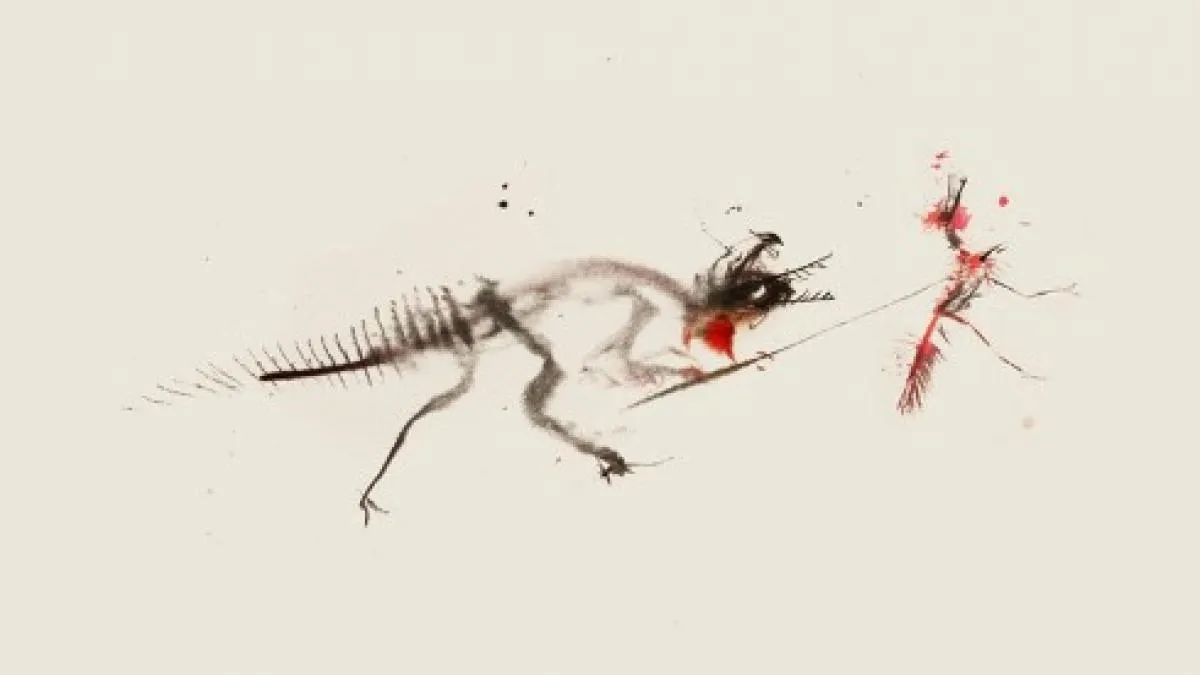
Dinosauroid cave art by CM Kosemen and Simon Roy.
The question is wether or not life emergence and life evolution is process that is mostly determined by inherent stabilities common to most sun-like star system formation processes with an earth-like planet within the habitable zone. We will be able to answer partially to this question when we will develope the technology to measure the atmospheric content of thousand of earth-like planets and to observe the presence of forest land mass on the surface of thousand of such planets. At this early stage of the development of the biological sciences on this planet, I do not see why it is unscientific to think that life evolution might be mostly deternistic and marginally contingent.
The human mind is structured like the scientific method. At the lowest level are observations, which requires paying attention. At the level of inquiry, humans ask questions and extremely intelligent humans invent theories or answers. At the level of reflective judgment, humans marshal the evidence and decide whether a theory is true or just probable. This requires being rational.
That the human mind is a mystery is an answer to the question: What is the relationship between myself and my body? The evidence supporting this theory is that the other theories (dualism, materialism, and idealism) have very little evidence supporting them. Catholic philosophers and theologians judge this theory to be true.
"The human mind is structured like the scientific method."
I beg to differ, cognitive ability is what may be structured like the scientific method, the brain / mind is not. Not that any of that seems in any way connected to what follows.
"That the human mind is a mystery is an answer to the question: What is the relationship between myself and my body?"
Ummm that's not actually an answer, it's an essentially empty statement that explains nothing.
"The evidence supporting this theory is that the other theories (dualism, materialism, and idealism) have very little evidence supporting them."
That's not evidence that's just an observation about other hypotheses' which says absolutely nothing about your hypotheses. It's not a case of the others are weak therefore this alternative is true, it don't work like that.
"Catholic philosophers and theologians judge this theory to be true."
You're kidding me, an appeal to authority!? That's bad enough but appealing to unspecified know nothings like Catholic philosophers and those with degrees in the study of nothing? I honestly couldn't care less what those folks judge to be true, their opinion doth not confer validity and is not worth a hill 'o' beans in the end.
I'v given the evidence that the mind-body problem is a mystery. If you don't agree, it means either you have bad judgment or I have bad judgment.
However, most atheists don't have bad judgment. They fail at the level of intelligence. The only solutions to the mind-body problem they understand are materialism and dualism. They can't even grasp the theory that the human mind is a mystery.
Many atheists will admit that free will and conscious knowledge are mysteries. But if you ask them what caused the Big Bang, they will say: It is a mystery. They can't grasp the difference between scientific questions and question that arise from our ability to make ourselves the subject of our own knowledge.
"I'v given the evidence that the mind-body problem is a mystery. If you don't agree, it means either you have bad judgment or I have bad judgment."
I'm sorry but arguments from authority and non-sequiturs are not, by any stretch of the imagination, evidence. Not one scintilla of evidence has been proffered by you nor do you answer most criticisms leveled, plumbing for silent avoidance instead. It's got nothing to do with judgment good or otherwise, it's simply poor argument by you.
"However, most atheists don't have bad judgment. They fail at the level of intelligence."
Very good, some poisoning of the well now, tell me, are you trying to commit as many fallacies as possible?
"The only solutions to the mind-body problem they understand are materialism and dualism."
Heavens to Betsy no!? You mean those reprobates don't subscribe to notions that leave space for his lordship to operate?
"They can't even grasp the theory that the human mind is a mystery."
I'm afraid no rational person could grasp such an illogical construct. Saying the human mind is a mystery - in other words an I don't know statement - is emphatically not a theory it's not even an hypotheses, it's simply a declarative statement on a position and that explains nothing. A theory would require a premise that would be demonstrated with evidence, "I don't know" or "it's a mystery" are not premises they're an admission to a lack of knowledge and nothing more.
"Many atheists will admit that free will and conscious knowledge are mysteries. But if you ask them what caused the Big Bang, they will say: It is a mystery."
You could have just put all three in the same sentence but yes, most atheists and rational people have no problem saying they don't know the answer to a scientific conundrum, yet. However, I suspect you think this is some kind of 'gotcha' moment.
"They can't grasp the difference between scientific questions and question that arise from our ability to make ourselves the subject of our own knowledge."
Oh deary me you do. I'm sorry but these are all scientific questions, I mean..., hold on you're not one of those that think over there is science's realm whilst over here is a special little place for theology and such? Alas science is in the business of inquiry which includes the BB, free will and consciousness. The latter two arise from the very physical brain and its electro-chemical interactions and thus are eminently researchable. Science also reliably gives us answers and advances knowledge whereas the other does not, not one discovery attributable. Now if you wish to pretend otherwise then by all means do so, but your pretence, assertions and non-sequiturs do not and never will alter reality or make idle statements of ignorance into hypotheses, never mind theories.
Can “human-like intelligence” have evolved? The first step in answering this question is to define the word "intelligence." When animals have nothing to go to they go to sleep. Humans, however, ask questions about what they observe. Humans want to know what causes things and what the relationship is between things. But what is "causality"? What are "relationships"? I suggest that the concept of intelligence can’t be defined or explicated. Hence, it is absurd to consider the evolution of human beings. Only the matter (bodies) of humans, not the form (souls) of humans, evolved.
I'd loosely agree, only our physical form evolves, the 'soul' cannot because there is none in the first place. Nothing can act on that which is not there.
As for the first step being to define the word 'intelligence', rather redundant if you almost immediately contend that it cannot be defined.
Humans like every other living thing evolved, therefore that which is part of us also evolved and that includes our capacity for reasoning, intelligence or whatever else it might be called. The brain did not pop into existence from point unknown. There are no absurdities here.
@Shadowwolf
We can comprehend "intelligence" because we have it. There are, of course, circular definitions: Humans are intelligent because they ask questions. Animals are not intelligent because they don't ask questions. This means humans are indefinabilities that become conscious of their own existence. Another way of expressing this is to say humans are embodied spirits.
The human soul is the metaphysical principle or incomplete being that makes humans equal to one another and superior to animals. The human body is the principle that makes humans different from one another. The human soul is spiritual because humans are embodied spirits.
Biological evolution does not consider free will and other indefinable structures of the human mind. It is not absurd to say the human mind is a mystery. It is a theory supported by the evidence and judged to be true by rational people.
"This means humans are indefinabilities that become conscious of their own existence."
I'd certainly not agree that humans are indefineables that's merely an assertion, and neither does it really follow from the preceding sentences. It certainly does not reasonably demonstrate the claim of humans as embodied spirits. It might be another way of expressing it but I don't find it to be a particularly useful way. What is intelligence? It's more than asking questions its; the capability to be aware of awareness; reasoning; to appreciate your place in the larger picture; to deliberately alter surroundings and refine the constituent elements for better use; to explain the world by breaking it down through science and build on that knowledge, to use discovered knowledge to better society and escape the confines of the world without external intervention; to exist at some measure beyond the whims of environment. These are all markers of intelligence and yes we humans set them because we can't step outside ourselves. Animals do not do these things, some approximate elements, birds build nests whilst other creatures dig out burrows but none of it is akin to the refining of materials and elaborate constructions we create, their intelligence is markedly lower than our own.
"Another way of expressing this is to say humans are embodied spirits.
The human soul is the metaphysical principle or incomplete being that makes humans equal to one another and superior to animals. The human body is the principle that makes humans different from one another. The human soul is spiritual because humans are embodied spirits."
Now that's circular reasoning. The human soul is not a metaphysical anything, there is no such thing unless you happen to have some evidence to the contrary.
"Biological evolution does not consider free will and other indefinable structures of the human mind."
It may not consider it, evolution doesn't really consider anything, but everything that we are whether you call it indefinable or not springs from the physical brain, nothing sits apart. Therefore modern homo sapiens, both physically and mentally, is a product of evolution.
"It is not absurd to say the human mind is a mystery."
Did someone?
"It is a theory supported by the evidence and judged to be true by rational people."
I'm sorry, are you suggesting that the claim, "the human mind is a mystery," is a theory and this is judged to be true because someone said so?